Fliki AI Alternative for Shorts

Stella writes SwipeStory guides about AI faceless video creation, short-form video strategy, creator tools, and automated publishing workflows.
The best Fliki AI alternative is SwipeStory when you want a focused workflow for original faceless Shorts, TikToks, and Reels from a prompt or script. Fliki is a strong AI video and voiceover platform with a deep voice catalog, multilingual tools, avatars, translation, blog-to-video, PPT-to-video, bulk creation, and AI video models. Choose SwipeStory when your main job is repeatable no-camera short-form creation with AI visuals, voiceover, captions, music, rendering, and scheduled publishing.
Updated June 19, 2026. We checked Fliki's current homepage, pricing page, text-to-video page, idea-to-video page, voiceover page, voice catalog, credit guide, SwipeStory's public pages, YouTube Shorts documentation, and TikTok ad specifications before writing this comparison. Product pricing, credits, model access, exports, and publishing features change often, so verify the linked pages and live checkout before buying.
Quick Verdict
| Need | Better fit | Why |
|---|---|---|
| A huge AI voice catalog, multilingual voiceover, dubbing, or avatar options | Fliki | Fliki publicly emphasizes 2,000+ voices, 80+ languages, voice cloning, avatars, translation, and many input types |
| Original faceless Shorts from prompts or scripts | SwipeStory | SwipeStory is focused on vertical short-form videos with visuals, voiceover, captions, music, rendering, and scheduled publishing |
| Blog posts, PPTs, URLs, or training material turned into videos | Fliki | Fliki supports broad text-to-video workflows beyond creator Shorts |
| A repeatable no-camera TikTok, YouTube Shorts, and Reels series | SwipeStory | The workflow is simpler when every video starts as a topic, script, or series idea |
| Both multilingual video assets and short-form social output | Use both deliberately | Use Fliki for voice-heavy or multilingual assets, then use SwipeStory for recurring original social episodes |
If your real bottleneck is voice selection, dubbing, avatar presenters, or turning existing business material into video, Fliki deserves a serious test. If your bottleneck is producing more original faceless short-form videos without filming, start with SwipeStory's faceless AI video generator, Script to Video AI, or Prompt to Video.
What Fliki Does Well
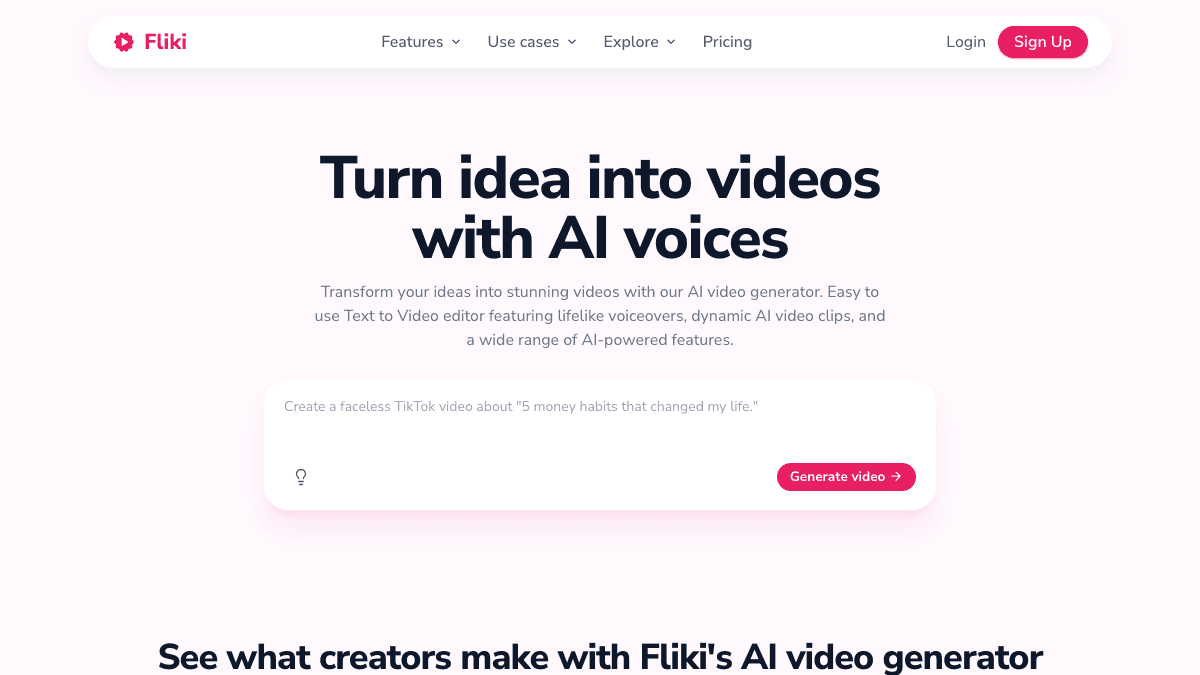
Fliki's homepage positions the product around turning ideas into videos with AI voices. The current page describes text-to-video, idea-to-video, blog-to-video, PPT-to-video, avatar video, AI voiceover, thumbnail creation, translation, screen recording, and auto-editing. It also says creators can make faceless TikToks and Reels without showing their face, use templates for TikTok, Reels, and YouTube Shorts, and publish to TikTok, Instagram, and YouTube.
That breadth matters. Fliki is not only a text-to-speech tool anymore. It is a broad AI video workspace with voice, translation, avatars, templates, screen recording, editing, model access, and multiple source inputs.
Fliki is worth testing if:
- You care deeply about voice choice, language coverage, accents, emotion, pacing, and cloning.
- You need the same video or voiceover in many languages.
- You want to turn blogs, scripts, slides, PDFs, product notes, or training material into video.
- You want avatar or digital-twin style videos.
- You need bulk rendering, brand kits, or a broader AI media workspace.
- You publish a mix of social posts, explainers, training videos, product videos, and YouTube content.
The tradeoff is category focus. A broad AI video workspace can be powerful, but creators looking for a Fliki AI alternative often want fewer choices, not more. A faceless Shorts workflow needs a clean path from topic to hook, script, visuals, voiceover, captions, render, review, and schedule. That is where a focused short-form tool can be easier to run every week.
Fliki Pricing Signals Checked June 19, 2026
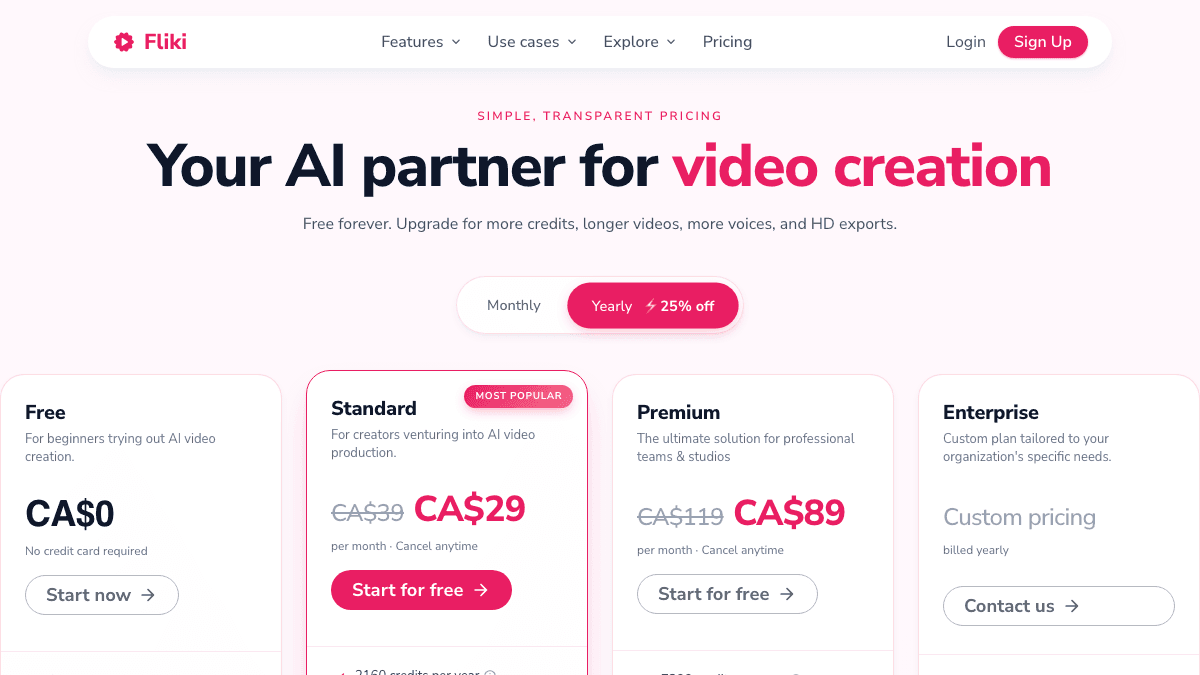
The live Fliki pricing page rendered Free, Standard, Premium, and Enterprise plans during this check. In our browser session, the visible annual plan cards displayed localized Canadian-dollar prices, so treat exact amounts as checkout-specific. The more useful buying signal is the limit structure.
The public pricing copy showed:
| Plan signal | Free | Standard | Premium |
|---|---|---|---|
| Credits | 3 credits per month on the card, and 36 in the yearly comparison table | 2,160 credits per year | 7,200 credits per year |
| Voices | 300 voices across 80+ languages | 1,000 voices, including 500 ultra-realistic voices | 2,000+ voices, including 1,000+ ultra-realistic and multilingual expressive voices |
| Resolution | 720p videos with Fliki watermark | 1080p videos | 1080p videos |
| Export length | 1 minute | Up to 15 minutes | Up to 40 minutes |
| Notable upgrades | Ideas, scripts, blog posts, PPTs, stock assets, AI images, thumbnails | Voice cloning, limited stock avatars, commercial rights | AI video clips, photo avatars, all AI avatars, multiple voice cloning, brand kits, custom fonts, priority support |
Fliki also publishes a detailed credit calculations guide. It says standard voice costs 0.5 credits per minute, multilingual, ultra, studio, or cloned voices cost 1 credit per minute, workflow starts such as idea, script, or blog URL cost credits when submitted, AI image and AI video usage varies by model, and exporting costs additional credits per minute. That is the key comparison point: the price is only one part of the cost. The chosen voice, visual source, AI video model, export attempts, translation, and revisions all affect the effective production cost.
For SwipeStory, check the current pricing page before planning a high-volume series. The public page checked on June 19 showed credit-based creator plans with series counts, custom AI voiceovers, background music, auto-captions, no watermark, automated posting, and fast video generation. It also still displayed sale copy tied to June 14, so verify checkout before comparing exact dollar amounts.
Fliki vs SwipeStory
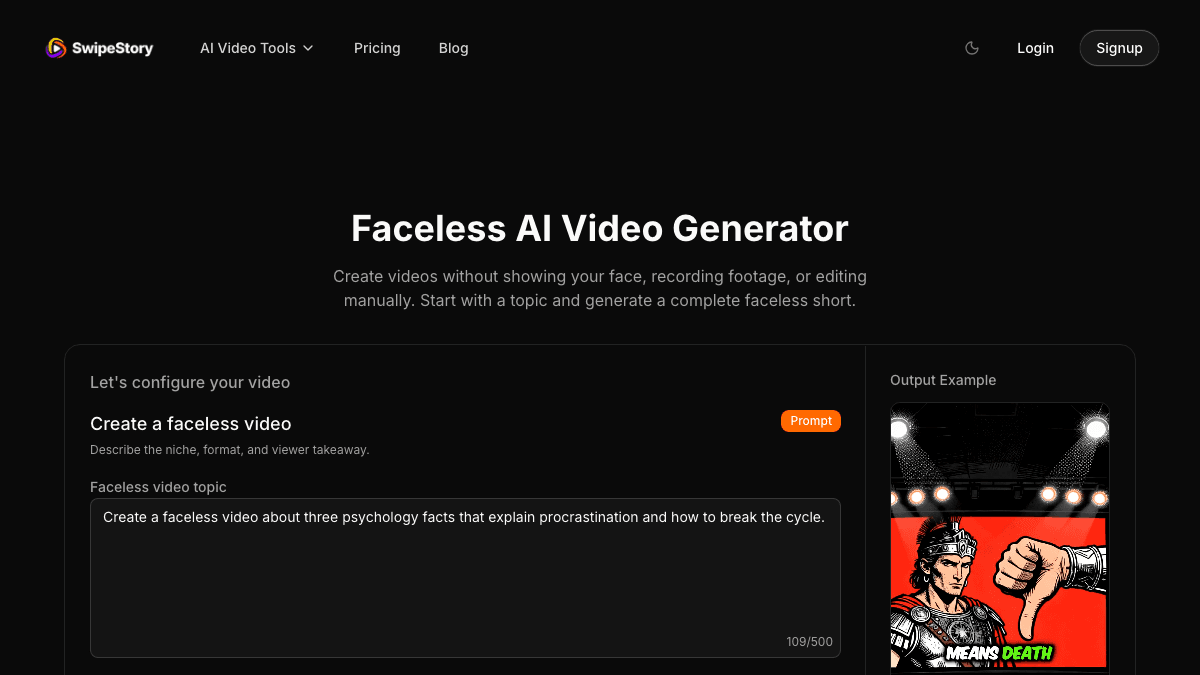
SwipeStory is the stronger Fliki AI alternative when the core job is original faceless short-form generation. It turns prompts or scripts into vertical videos with AI-generated visuals, voiceovers, captions, background music, editing, rendering, and scheduled publishing for TikTok, YouTube Shorts, and Instagram Reels.
Fliki is broader. SwipeStory is more focused.
| Question | Fliki | SwipeStory |
|---|---|---|
| What do you start with? | Idea, script, blog URL, PPT/PDF, product brief, recording, avatar concept, or text-to-speech input | Topic, prompt, approved script, niche idea, or faceless series concept |
| Core strength | Voice catalog, multilingual video, broad AI media workflows, avatars, translation, and bulk creation | Repeatable original vertical videos for social platforms |
| Best user | Creator, educator, marketer, L&D team, agency, founder, or team with many content formats | Creator building no-camera TikToks, Shorts, and Reels from ideas |
| Voiceover | A headline feature with a large voice catalog and language coverage | Built into the generated short-form workflow |
| Visual workflow | Stock, AI images, AI video clips, avatars, templates, and editor controls | AI-generated visuals and styles assembled around short-form scripts |
| Publishing fit | Public pages mention publishing and series; verify plan limits and social-account needs | Built around social-ready short-form output and scheduled publishing |
This is why a simple feature list can mislead you. Fliki may have more total creation modes, more voice options, and stronger multilingual breadth. SwipeStory can still be the better fit if your actual production system is narrower: one faceless channel, one weekly content calendar, one repeatable video format, and a need to move from idea to finished short without building a broad media workspace around every post.
For example, a course company with slide decks, training scripts, product explainers, and localization needs may prefer Fliki. A creator making daily "strange history" or "psychology facts" shorts may prefer SwipeStory's AI TikTok video generator, AI YouTube Shorts generator, or AI Reel generator because the workflow is already pointed at short-form social output.
The AI Voiceover Decision
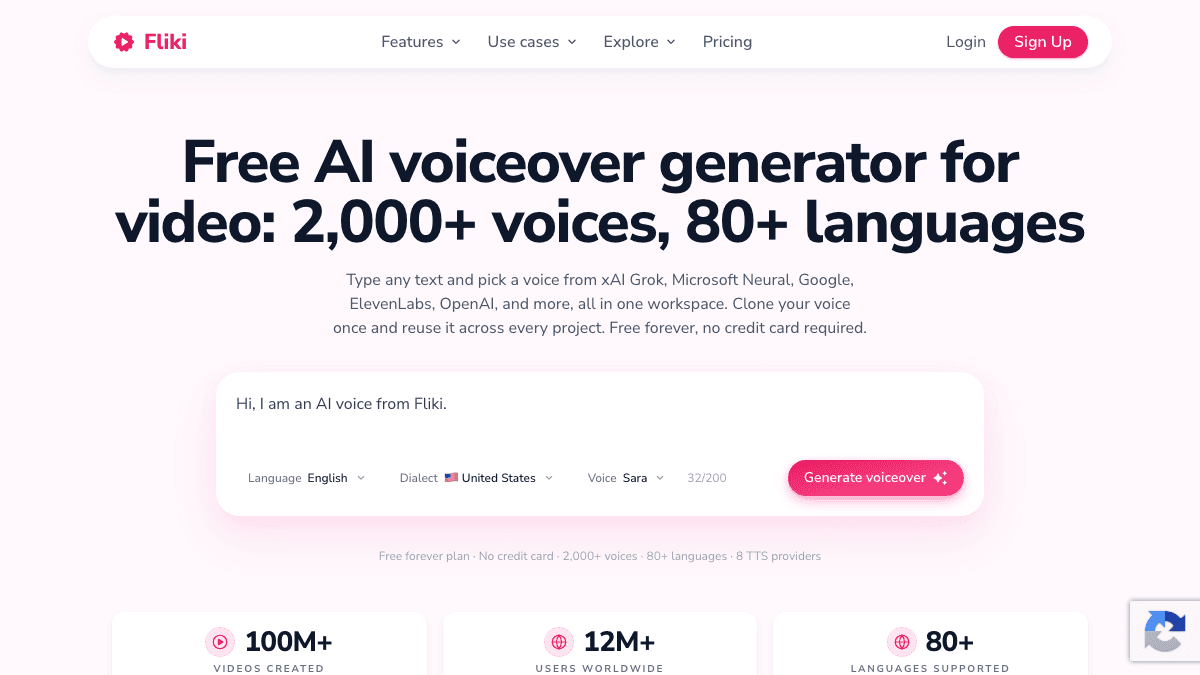
The Fliki alternative search often starts with voiceover. Fliki's AI voiceover page says it produces video-ready AI voiceover in 2,000+ voices across 80+ languages. Its voice catalog went further during this check, showing 2,531+ voices, 82+ languages, 153+ dialects, and eight TTS providers.
That is a real advantage if voice is the buying center. You may need regional accents, multilingual variations, voice cloning, audio exports, dubbing, or many narrator options for the same script. In that case, Fliki may be closer to the right tool than a narrower short-form generator.
But voiceover is only one layer of a finished short. A video can have a good narrator and still fail because the hook is weak, captions are hard to read, visuals do not match the spoken beat, the music competes with the voice, or the output needs another editor before posting.
Use this decision rule:
| Starting problem | Better category |
|---|---|
| "I need better voices, accents, dubbing, or cloned narration" | AI voiceover and multilingual video workspace |
| "I have a script, blog post, or slide deck and need a narrated video" | Text-to-video or business video suite |
| "I have a topic and need the whole Short built" | Faceless AI video generator |
| "I need to publish a weekly social series without filming" | Short-form generation and scheduling workflow |
| "I need both voice localization and recurring social posts" | Use a voice-first tool for localization and a short-form workflow for recurring episodes |
If you are still deciding how to structure narration, read the AI voiceover video maker guide and AI video script generator guide. The best output usually starts with a script written in spoken beats, not a long paragraph pasted into a voice tool.
When Fliki Is the Better Choice
Choose Fliki when your workflow is voice-heavy or multi-format:
- You need many voices, languages, dialects, or pronunciation options.
- You are localizing the same script for multiple markets.
- You want avatars, digital twins, or presenter-led formats.
- You create explainers, training videos, product content, YouTube videos, and social posts from one workspace.
- You already have blogs, slide decks, PDFs, product notes, or scripts to convert.
- You need brand kits, bulk creation, custom fonts, API access, or team collaboration.
For example, an L&D team creating onboarding videos in several languages should test Fliki first. The source material likely exists, localization matters, and voice coverage is central. A software company repurposing blogs and slide decks into narrated videos may also benefit from Fliki's broader input support.
Fliki is also a stronger choice when the output is not always a TikTok, Short, or Reel. If you need 16:9 YouTube videos, training modules, narrated product walkthroughs, translated explainers, and avatar videos, a wider AI video workspace is useful.
When SwipeStory Is the Better Choice
Choose SwipeStory when your workflow is generation-led and short-form first:
- You do not want to film yourself.
- You start from a topic, prompt, niche idea, or finished short script.
- You publish mostly TikToks, YouTube Shorts, and Instagram Reels.
- You need AI visuals, voiceover, captions, music, editing, rendering, and scheduling in one flow.
- You want a repeatable faceless series instead of one-off media projects.
- You want the tool to stay close to the social-video format instead of becoming a general media suite.
For example, a creator planning 30 "one-minute finance myths" does not need to build a multilingual training-video workspace. They need repeatable hooks, narration, scenes, captions, music, review, and publishing. In that case, SwipeStory's faceless AI video generator, Prompt to Video, and Script to Video AI are more direct.
If you are comparing adjacent tools, read the Pictory AI alternative, InVideo AI alternative, and VEED AI alternative guides. Those products sit near Fliki, but each has a different workflow center.
A Practical Switching Test
Do not migrate your whole workflow because a tool has a larger feature list. Run a one-hour test with the same idea in both systems.
Use this structure:
- Pick one niche and one platform, such as Instagram Reels for productivity tips.
- Write three hooks and one 120-word narration script.
- Create one draft in Fliki using the voice and video workflow that best matches the script.
- Create one draft in SwipeStory using the same idea or script.
- Review both on a phone-sized frame.
- Count manual fixes: script cleanup, voice fit, visual mismatch, caption edits, music balance, export settings, and scheduling steps.
- Choose the workflow that makes video two easier than video one.
The last step matters. A strong AI shorts workflow should get easier with repetition. If each draft still feels like a custom editing project, the tool may be powerful but misaligned with your publishing cadence.
Platform Checks Still Matter
No Fliki AI alternative removes the final platform review. You still need to check length, aspect ratio, safe zones, caption readability, music rights, synthetic-media labeling, and whether the video works without extra context.
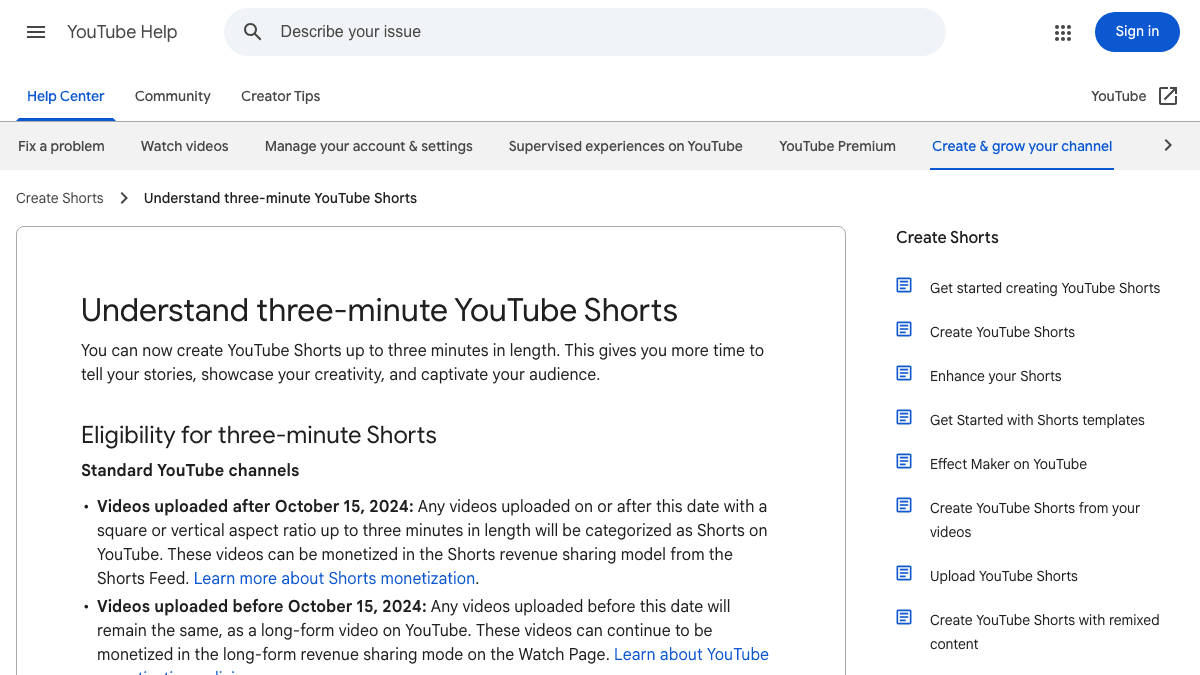
YouTube Help currently says standard channel videos uploaded after October 15, 2024 with a square or vertical aspect ratio and length up to three minutes are categorized as Shorts. It also says Shorts over one minute with an active Content ID claim can be blocked globally until the claim is resolved.
TikTok's in-feed ad specifications are ad-focused, but they are useful production guardrails. The page was last updated March 2026 and recommends vertical 9:16 creative for Non-Spark in-feed ads, lists common file formats such as MP4 and MOV, and points advertisers to safe-zone files because app UI can affect what remains visible.
Before publishing an AI-generated or repurposed short, check:
- Is the hook clear in the first seconds?
- Are captions readable on a phone?
- Are faces, products, CTA text, and key visuals away from bottom controls?
- Does the video make sense without the original blog, slide deck, or prompt?
- Are music, source footage, stock assets, generated visuals, voices, and avatars licensed for the use case?
- Does realistic synthetic voice or avatar content need a platform label?
- Can you repeat the format tomorrow without rebuilding the whole production process?
Final Recommendation
Use Fliki if your biggest bottleneck is voice, language coverage, translation, avatars, or turning existing text-heavy assets into narrated videos. It is a strong AI voiceover video tool and a broad AI video workspace.
Use SwipeStory if your biggest bottleneck is creating original no-camera short-form videos from ideas. It is the better Fliki AI alternative for creators who want a focused prompt-to-video or script-to-video workflow for repeatable TikToks, YouTube Shorts, and Instagram Reels.
The practical decision is simple: if voice and localization are the center of the job, test Fliki. If a recurring faceless social series is the center of the job, test SwipeStory and compare how many reviewable vertical drafts you can produce in one focused session.
Frequently Asked Questions
What is the best Fliki AI alternative for Shorts?
SwipeStory is the best Fliki AI alternative when you want to generate original faceless Shorts from prompts or scripts. Fliki is better when voice choice, multilingual narration, avatars, or broad text-to-video workflows are the priority.
Is Fliki better than SwipeStory?
Fliki is better for voice-heavy, multilingual, avatar, and multi-format AI video workflows. SwipeStory is better for focused short-form generation, especially no-camera TikToks, YouTube Shorts, Instagram Reels, and repeatable faceless video series.
Can Fliki make faceless videos?
Yes. Fliki's public pages describe faceless short-form video creation, AI voices, templates, captions, publishing, and idea-to-video workflows. You should still compare output quality, credits, editing time, and platform review steps against your real publishing cadence.
What should I use instead of Fliki for faceless Shorts?
Use SwipeStory when you want a faceless video maker that starts from a topic, prompt, or script and builds the short around AI visuals, narration, captions, music, rendering, and publishing.
Should I use Fliki and SwipeStory together?
Yes, if your workflow has both voice localization and original social-video generation. Use Fliki for multilingual voice or broad video assets, and use SwipeStory to create repeatable faceless short-form episodes from new prompts or scripts.